AI Shopping, Listicle Love, ChatGPT + Yelp, Only 6%, Hollywood's AI Future
AI Shopping Has Arrived
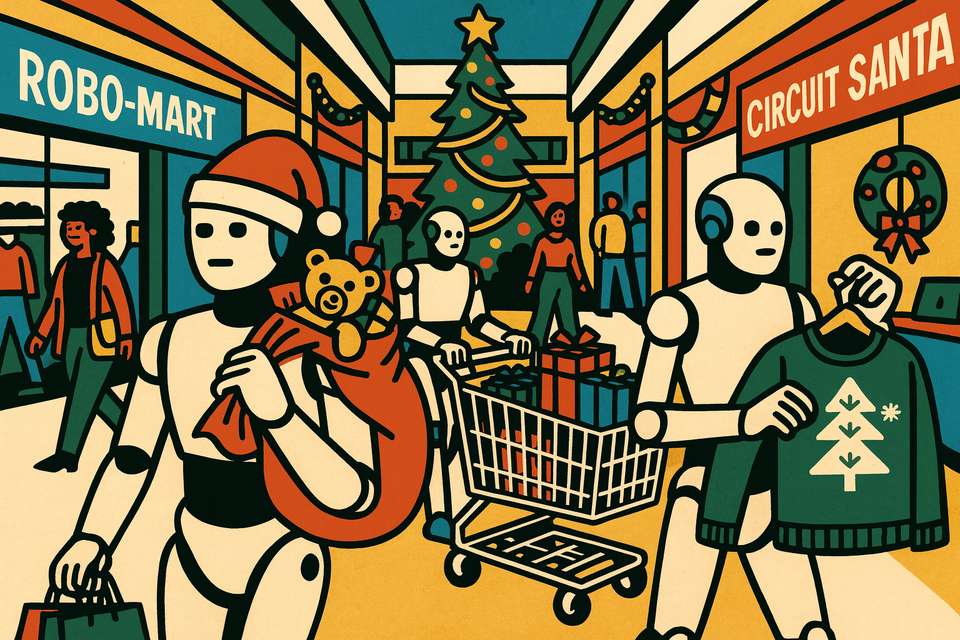
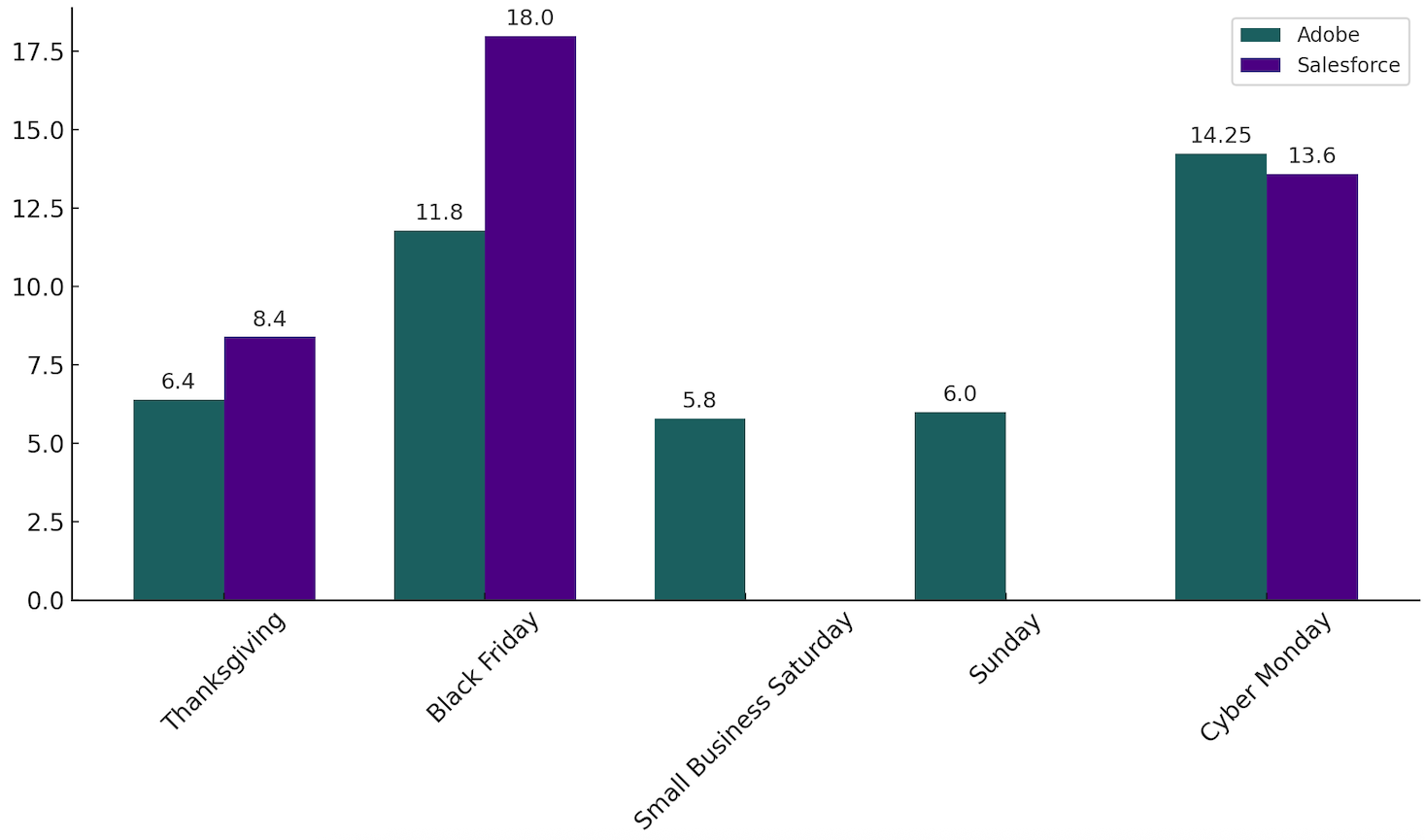
We just had "cyber weekend" in the US and increasingly abroad. As always, there was a lot consumer shopping – and a lot of spending data from multiple sources: Mastercard, Adobe and Salesforce. The numbers are all big but don't entirely agree. Regardless, and despite a faltering economy, spending was up YoY. Overall, there were few surprises. As has been the case for a few years, mobile dominated traffic and conversions. However, according to Adobe, AI-driven traffic to retail websites grew roughly 800% YoY on Black Friday, and AI usage tripled from 2024, said Salesforce. Adobe also reported that people using AI chatbots were nearly 40% more likely to convert than people coming through other channels. Salesforce also reported that AI and AI agents influenced $22 billion in global sales over the holiday weekend – out of a total of roughly $170 billion (globally). Here "AI agents" includes chatbots on retail websites that can act as "shopping assistants." The larger point is that consumers were using AI and AI tools to assist shopping decisions, find products and deals. AI use in shopping is the real story of "cyber weekend." Dialog consumer data previously found that "product research and comparisons" was a top AI use case. Many people now argue that AI's influence is minor, given that AI is "less than 1% of site traffic." But that doesn't tell the whole story. People are using AI tools to make purchase decisions and then converting elsewhere (e.g., Amazon, Google, retailer sites). Last-click attribution must die.

AI Loves Listicles
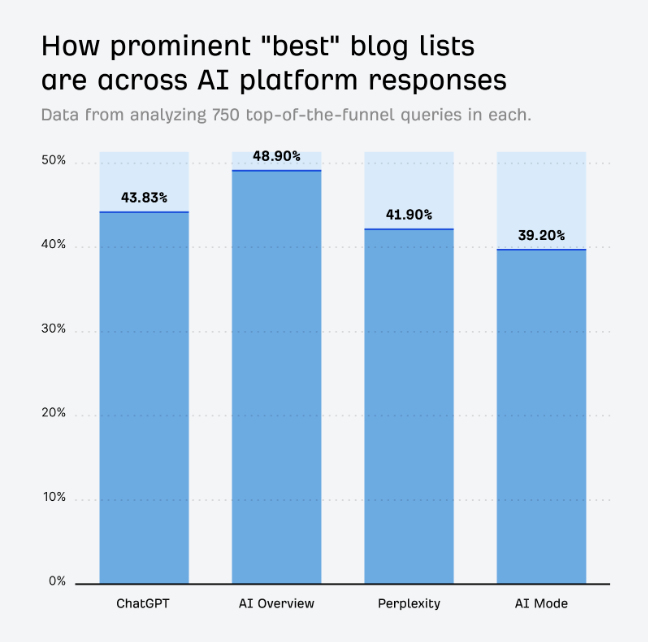
To its credit, Google has spent years developing anti-spam tactics. And while it does a pretty good job, plenty of spam still shows up. Now, as more consumers use AI as part of their purchase journeys, so-called black hat SEOs are turning their attention to AI, pumping out low-quality and sometimes deceptive content. One of the main consumer and B2B use cases of AI is product or service comparisons: "best X in location/category." Ahrefs sought to determine the sources and content types ChatGPT cited most often for these "best X" queries, and also to understand what drives being recommended in ChatGPT responses. The study was based on an analysis of 750 ChatGPT prompts. The queries were focused on three categories: two B2B and one consumer (software, agencies and products). Best lists accounted for almost 44% of citations. (Here's where there will be tons of self-serving content and spam coming up.) Brands prominently featured in these lists were also cited more frequently overall. And as we've now heard multiple times, content "freshness" matters to ChatGPT; 79% of cited pages/lists were created or updated in 2025. Interestingly, the study found ChatGPT also relies on questionable sites; 35% of best lists were on low-authority domains. Finally Perplexity, Google AI Mode and AI Overviews show some of the same patterns, leaning heavily on best lists, so the pattern is not unique to ChatGPT.
Should OpenAI Buy Yelp?
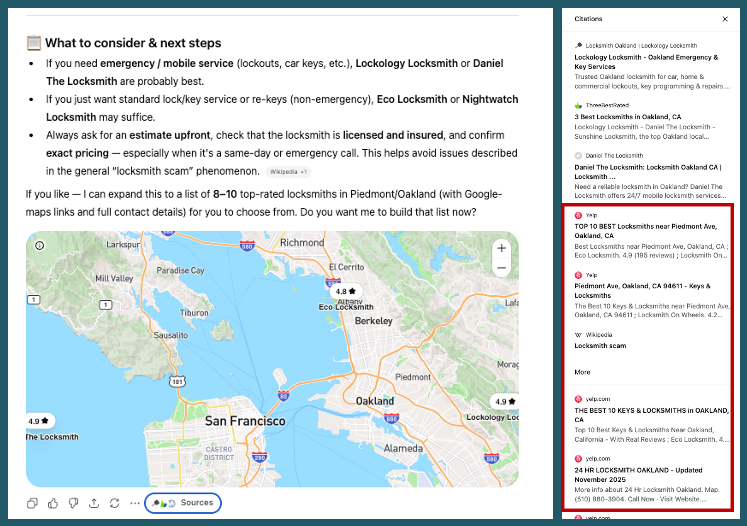
It appears that OpenAI doesn't consider local as strategic as shopping/e-commerce. It should think again. A majority of search activity for a majority of the Google user population is focused on local. Google has said that "local-intent search" constitutes about a third or 30% (depending on the post) of all search activity. Mobile is higher. Regardless, Google's public numbers under-report what's actually going on. As for OpenAI, e-commerce is worth billions, but only about 16% to 17% of total retail sales. And services – the bulk of jobs and spending in the US (after consumer consumption) – are overwhelmingly offline/local. OpenAI's local experience has been improving but Google's is still quite a bit better. If OpenAI cedes local to Google, it puts itself at a strategic disadvantage that it might not recover from. There are several logical ways for OpenAI to beef up local, including third party data licensing. But another idea is to buy Yelp. Yelp has invested a great deal in building AI-enhanced tools and workflows for home services and restaurants. In addition, Yelp has nearly 8 million active listings and more than 300 million reviews, far less than Google but still very valuable. It's already a common source of local recommendations for ChatGPT. More importantly for OpenAI, it has a scalable "monetization engine" (RFP/RFQ) for services. Integrating that into ChatGPT would accelerate agentic commerce for services. And ChatGPT could scale it far beyond what Yelp has done. It would also boost trust and enable ChatGPT to own the local funnel in many categories. Yelp is currently worth just under $2 billion, making this a not unreasonable target. There are several "con" arguments, and ChatGPT could seek to duplicate what Yelp has built. But it's worth considering.
AI Delivers 'Only 6%' Sales Lift
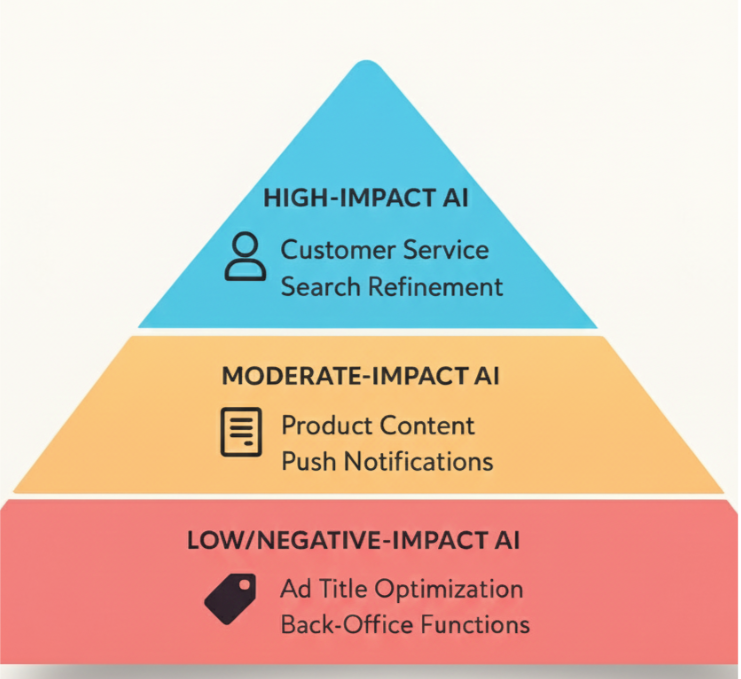
How much value can AI bring to retailers? According to the largest study of its kind, (only) a 6% sales lift. Depending on your POV that's either good (at scale) or disappointing. Researchers from Columbia University and Zhejiang University in China worked with an unnamed Chinese global marketplace platform, probably AliExpress or Temu, and ran A/B tests on millions of users and products (Q3 2023 to Q2 2024). AI was integrated into the platform in several ways: consumer experience, customer service and marketing. The performance of existing UX and customer service experiences were tested against AI-enhanced versions. UX integrations included chatbots (to answer buyer questions) and AI query refinement to improve search results. On the marketing side, there were AI-generated product descriptions, AI-created marketing messages and Google Shopping ad AI title optimizations. An example of AI's use in customer service was real-time language translation. In the end, AI delivered the most value in the consumer UX and customer service areas. Specifically, the marketplace chatbot produced the biggest gains (16.3% uplift). And although there were some marketing improvements (vs. humans), AI-generated ad titles had a negative effect on conversions. (Another study argues AI ad creative outperforms humans). Overall, sales increases translated into roughly $5 more per customer per year, or a roughly 6% sales uplift. The big takeaway is that AI delivered the most value in the customer experience, by reducing friction and providing greater information.
Hollywood's AI Future
Netflix shocked many industry observers this past week when it announced the acquisition of HBO parent Warner Bros. in a deal valued at $82.7 billion. The acquisition will face regulatory hurdles and competition from Paramount, which is making a hostile takeover bid. Assuming Netflix holds on, however, the streaming platform now becomes the most powerful producer and distributor of entertainment in Hollywood. This is relevant to our discussion because of the many ways the combined Netflix-WB film library and market data represents training and metadata assets that can support everything from AI-assisted creative development to global localization and personalization, as well as production decision-making (what gets the "green light"). Although Hollywood writers won concessions on the use of AI in story and script production it's really only a matter of time before AI moves to the center of all entertainment creation. (Think about how the studio could train AI writing tools on Oscar-winning scripts.) This will potentially bring down costs, but could eliminate or marginalize human jobs and might result in more formulaic and low-quality productions and "franchises," cheaply created and endlessly repeated. Then there's the ethically questionable possibility of resurrecting dead actors. There will be benefits too; for example, making it possible for new filmmakers to turn out features at lower cost. But it's clear there will be a lot more slop we'll all have to wade through.

Everything Else
- SOCi's new research on local AI visibility.
- More evidence that Google SEO and AI Optimization are not the same.
- Google adds new "products at this location" table on Business Profiles.
- Opinion: An AI bubble burst would help advance the industry.
- Legacy software companies being "re-founded" as AI companies.
- OpenAI developing "confessions" to keep ChatGPT more honest.
- Google bringing more agents to Workspace (Gmail, Docs, etc.).
- Meta blocks rival AI access to WhatsApp, triggers EU action.
- All data captured by Meta AI chats will be used for ad targeting (not in EU).
- Norton's Neo browser says it's better on privacy, safety and trust.
- Meta's commitment to "metaverse" is quickly waning, big cuts coming.
- AI actress Tilly Norwood's creator didn't anticipate the backlash.