AI vs. SaaS, SMBs Trust AI, Local Optimization, Claude Wins by Losing, ChatGPT Ads

Will AI Really Eat SaaS?
Over the past several weeks various AI announcements and product extensions (e.g., Claude Cowork plugins) prompted a huge market selloff of public SaaS companies. In a short time span almost $1 trillion in value was destroyed, and some vendors saw half their market capitalizations disappear. Financial markets are spooked and believe the industry is facing structural upheaval. Many analysts argue pricing models and competitive moats will erode and that feature gaps and switching costs will disappear. There’s a great deal of uncertainty about what happens next. But while it’s popular to argue SaaS will be swept away by the AI tide, there’s more to SaaS than a "dashboard over a database." These companies manage compliance, workflow permissions, audit trails and core operational data; they also provide service and support – yet emerging market pressures are real.
The main risk is that AI replaces the often painful SaaS UI/UX. And if AI becomes the front door to multiple SaaS APIs, individual brands potentially fade into the background. That would reduce vendor pricing power and make substitution potentially easier. Specialized SaaS training (e.g., Salesforce) would be less necessary, reducing loyalty and switching friction. Data migration would still be a barrier, but AI could eventually minimize that challenge. SaaS companies that emerge from this maelstrom will have deeply integrated AI, strengthened compliance, improved security (big one) and proprietary data advantages. Grudgingly, they may also need to embrace usage- or outcome-based pricing. Finally, a key "X variable" is service, which could become a major SaaS loyalty and retention driver, especially for SMBs.


SMBs Driving Trust Gains for AI
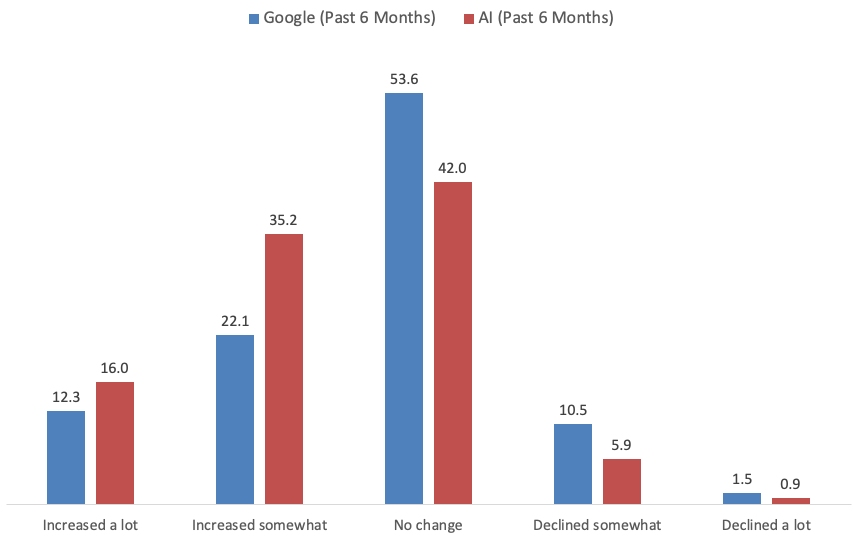
Small business owners tend to be an optimistic bunch. And that showed up indirectly in our recent AI Trust Survey data. One of the questions we asked was whether trust in AI results, especially in local results, was growing, flat or declining, and how did it compare to Google? When we asked about AI trust in general we found the number of people who moved into the "sometimes" category increased (vs. 2025) suggesting an erosion of overall trust. A bigger percentage give an unqualified "yes" six months ago. Despite this apparent erosion, trust grew for local results. A majority of local searchers said their trust in AI had increased. Roughly 51% said trust in AI for local was up "somewhat" or "a lot," almost 20 points higher than for Google. This difference may be explained by an existing, stable level of trust for Google.
When we slice the data by SMB (n=171) vs. consumer (n=289) something slightly more interesting appears. SMBs are responsible for more of the AI trust gains than consumers. They are more bullish on both Google and AI: 43% of consumers say AI trust has increased, but it's 21 points higher (64%) for SMBs. And SMBs are more likely to say AI local trust "increased a lot" (29% vs. 8%).
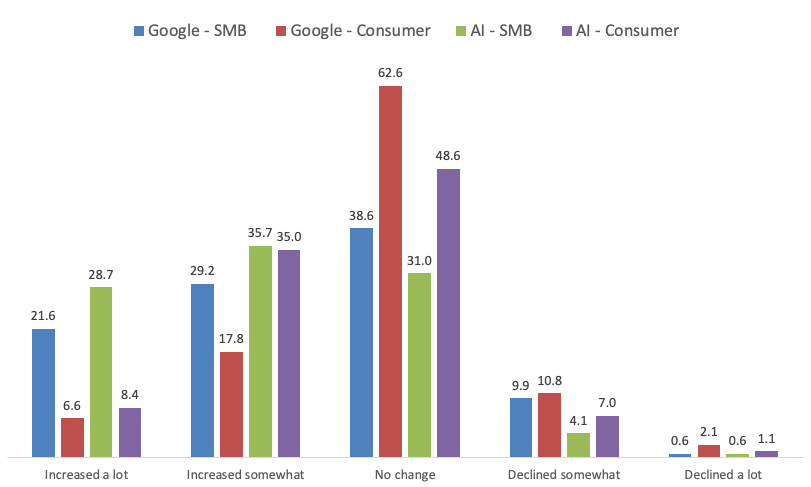
How do we explain this? It's probably engagement and usage. Our previous data argue that as people adopt AI, usage frequency grows over time. That comfort and familiarity is likely generating increased trust in general but especially among SMBs, who are using it for work-related purposes. They're more likely to see immediate, measurable gains. That is likely translating into more trust and confidence accordingly.
Yext: 'No Single AI Optimization Strategy'
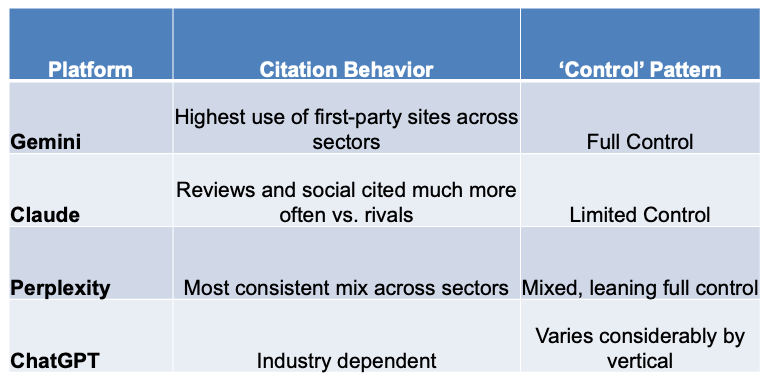
Search marketers have been trying to reverse engineer AI since the first appearance of ChatGPT. And there have been multiple studies about the top domains cited on the major platforms. Several studies have found "citation overlap" is minimal, less than 15% (e.g., here, here). Yext has now looked closely at local citations, which is quite different from the more pervasive "top domains" research. The first Yext citations study came out in Q4 2025. It argued local citations are influenced by multiple variables: location, context/memory and query type (branded/unbranded, objective/subjective). Yext identified a kind of hierarchy of brand control over AI sources: brand websites (full control) --> directory listings (e.g., GBP = some control) --> reviews and social posts (e.g., Google reviews = limited control) --> news and forums (e.g., Reddit = no control). A recently published follow-up study, analyzing 17 million citations on ChatGPT, Gemini, Claude and Perplexity in seven business verticals, found enough variability to declare "there is no single [local] 'AI optimization' strategy." Yet the main tactical takeaway is that most citations fall into the "full control" or "some control" categories. As a practical matter, the two platforms local marketers should address are Gemini and ChatGPT. So track and optimize for key directories, review and social sites in relevant verticals on those two AI platforms.
ChatGPT, Claude & Ethical AI
For the first time Claude topped the rankings of free apps in the iOS App Store. This came after Anthropic said it wouldn't allow the US Defense Department (DoD) to use its AI technology for mass domestic surveillance and autonomous weapons. The US blacklisted Anthropic for defying the DoD's demand and OpenAI immediately filled the void, signing essentially the deal Anthropic declined last Friday. Now the company is in damage control mode as a "delete ChatGPT" backlash is gaining momentum. According to multiple sources, Claude's app downloads are way up ("20x what they were in January"), while ChatGPT uninstalls have surged nearly 300% according to Sensor Tower. OpenAI is now saying it has amended its agreement with the Pentagon to protect against violations of Americans' civil liberties, but that may not be enough. OpenAI seems to have done some significant damage to the ChatGPT brand.
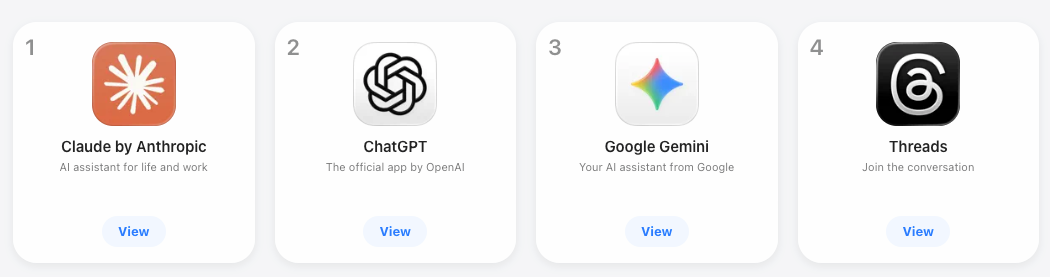
Trust is an under-appreciated element of brand affinity and loyalty. It's often taken for granted by tech companies. For the consumer public, as opposed to developers and enterprises, AI is mostly about brand awareness, peer usage and much less about specific capabilities. People are increasingly using more than one AI tool these days, as it becomes a quasi-commodity. For those who argue personalization is a moat for ChatGPT, Claude has now made it easier to switch. Ethical standards are important in themselves. But from a marketing standpoint, corporate ethics and brand reputation are often closely intertwined. And their perceived abdication has consequences (e.g., Target's decline).
ChatGPT Ads: Useful or Creepy?
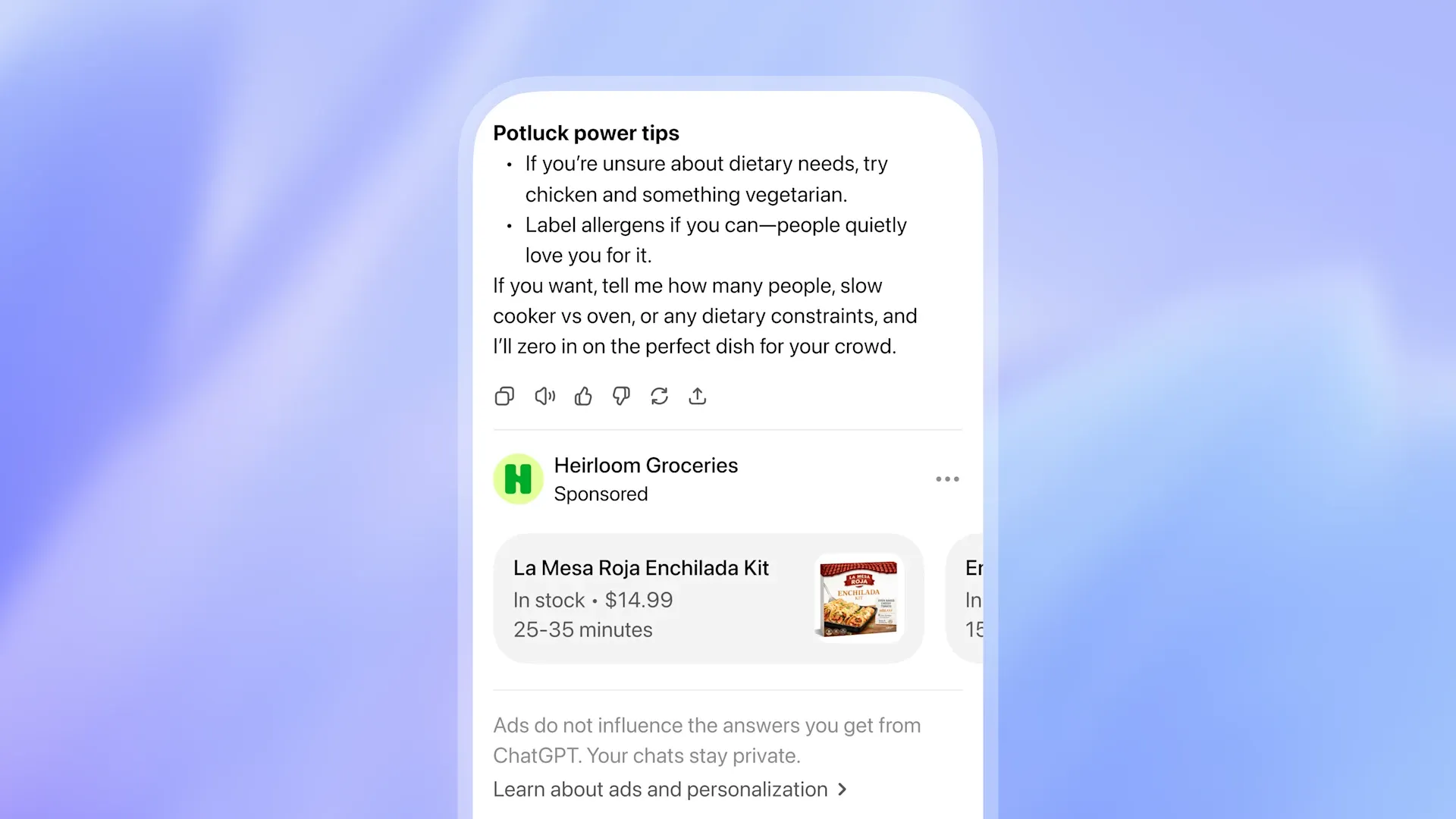
Some early ChatGPT ads have been spotted in the wild. It's too soon to generalize but they appear to be a mix of contextual and personalized placements. Their relevance has been disputed and they've already been characterized as "aggressive." Going the other direction, the Financial Times reported that Perplexity, which originally had high hopes for ads, was ending its program. The company said ads would erode user trust. (I suspect Perplexity was not seeing meaningful revenue.) Some industry observers are bullish on AI ads and see a significant opportunity that can draw upon the wealth of personal information users submit to ChatGPT. By analogy, social media seems to validate that proposition. But a former OpenAI researcher worries AI ads could quickly exploit user vulnerabilities. She points out that people reveal themselves in unprecedented ways to AI, which might be used to manipulate them. Ultimately, she doesn't argue against banning ads, but says stronger governance is the key to ethical AI advertising. OpenAI has pledged to be transparent, give users control and not show ads in sensitive categories. AI ads could work well, especially if they're highly relevant, interactive and observe guardrails. Yet the need for revenue may cause OpenAI to push boundaries beyond what may be fully ethical.
Lightning Round:
- A data-driven case for why ChatGPT is still winning.
- Growing overlap of ChatGPT and Gemini users.
- Review platforms show up more with higher intent AI queries.
- AI doesn't reduce work, it intensifies it and burns people out.
- AI job disruption now real for many white-collar/knowledge workers.
- Supreme Court turns down AI visual art copyright case.
- AI seeping into all aspects of everyday life.
- AI data center construction a political hot button.
- AI adoption now part of performance evaluations at big tech.
- Meta smart 'glassholes' are recording you in restaurants.
- Burger King using AI to monitor staff "friendliness."
- How freelance journalists are incorporating AI into their work.