
Precise Location, Ask Maps, Gemini Gains, Apple Advantage, AI-Driven Journalism

OpenAI Location Sharing
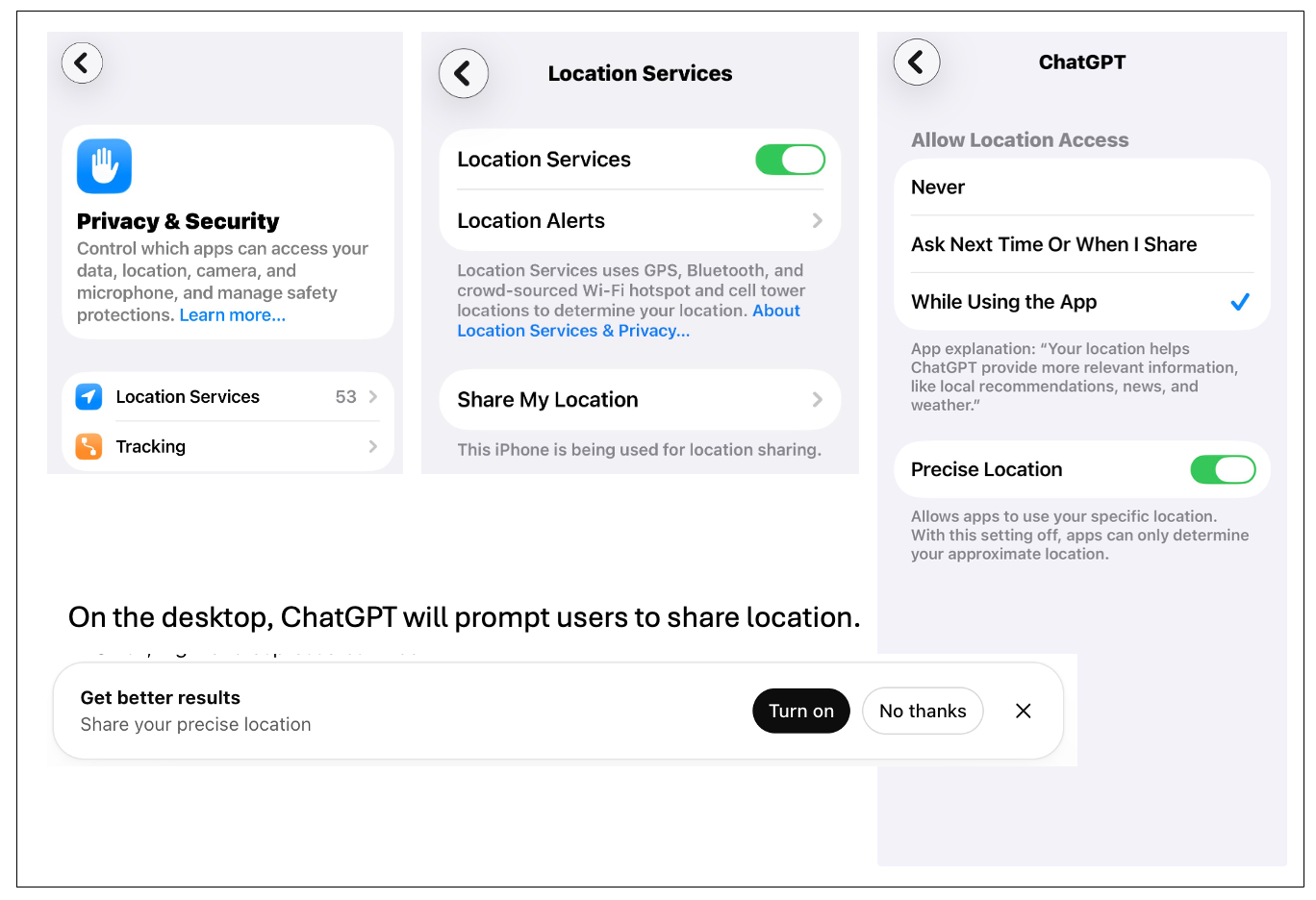
In its March 26 ChatGPT release notes, OpenAI introduced location sharing, which can now tap into the device's precise location. "Enabling location sharing will also enable precise location. Precise location means ChatGPT can use your device’s specific location, such as an exact address, to provide more tailored results." This would include better "near me" results but also, potentially, other improved local responses. People have been doing local searches on ChatGPT since its initial release but this could reinforce local usage and engagement. After enabling it on the iPhone I did see different "near me" results vs. the desktop version, where I was also prompted to share precise location. One can still use approximate location without turning on precise location. (I'm not systematically testing it so I can't tell if it's truly better vs approximate location.) Local is an area where Google is perceived to have (and actually has) a meaningful advantage over ChatGPT. Precise location also potentially opens the door to deeper local ad targeting and perhaps targeting based on location history. The announcement itself is silent about the use of location in ChatGPT advertising; it only says that location sharing is off by default and users have control over the feature. But in theory, ChatGPT could now begin to target ads based on intent, location and context.

Ask Maps Is the Future of Local
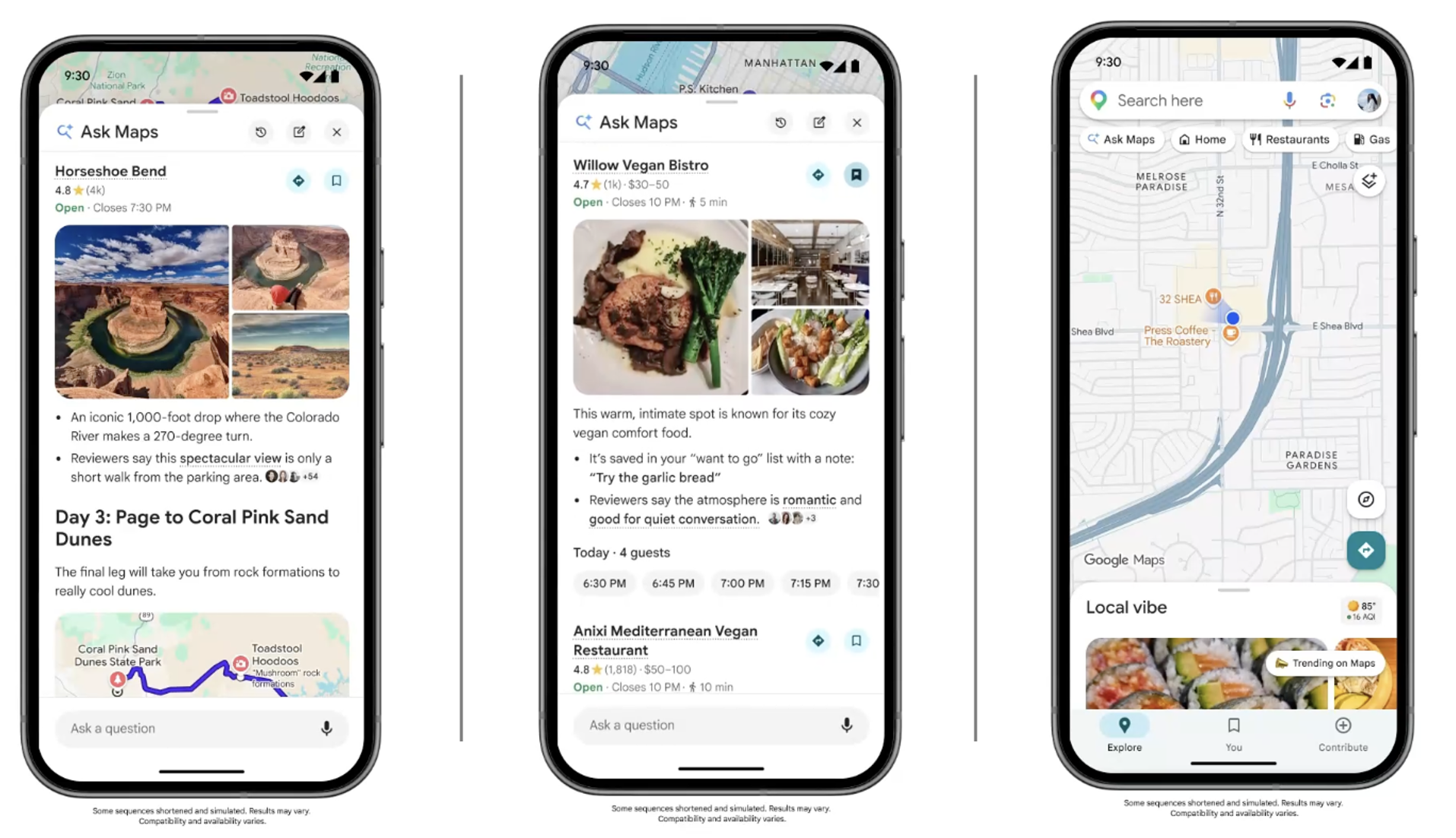
Google has been steadily integrating AI into search. Beyond AI Overviews (AIOs) and AI Mode, it's bringing conversational capabilities into Google's more traditional local search experiences. In January last year it started testing "Ask Maps about This Place" in Google Business Profiles (GBP). That allowed users to ask conversational questions about a particular business or location. The information was drawn from GBP, user reviews, the business website and third-party sources. It was effectively a replacement for Google Q&A. Then, in July last year, it introduced adjacent functionality, with the ability to ask AI to get pricing information from local businesses. And more recently Google added an "Ask Maps" button to Google Maps under the main search bar. That draws upon Google's entire local graph: 300 million places and "reviews from our community of more than 500 million contributors" (aka local guides). If you enter through Ask Maps vs. the traditional search bar you get a very different experience that more closely resembles AI mode. It allows users greater flexibility and precision in their queries and, in my experience so far, it's better than traditional Google Maps results for other than very simple searches. The UI is somewhat awkward but I assume this is simply a transitional step. The implications are significant and potentially change the function of GBP and reviews, making them data inputs to answer user questions – mirroring the coming shift for websites with AI generally. Marketers will need to start thinking about customer intent, FAQs and the user journey much more directly in managing their GBPs. People like to argue that Google is simply going to swap in AI Mode for general SERPs. I don't think that's exactly right, but this definitely seems like the future of Maps.
Survey: AI Gains but So Does Google
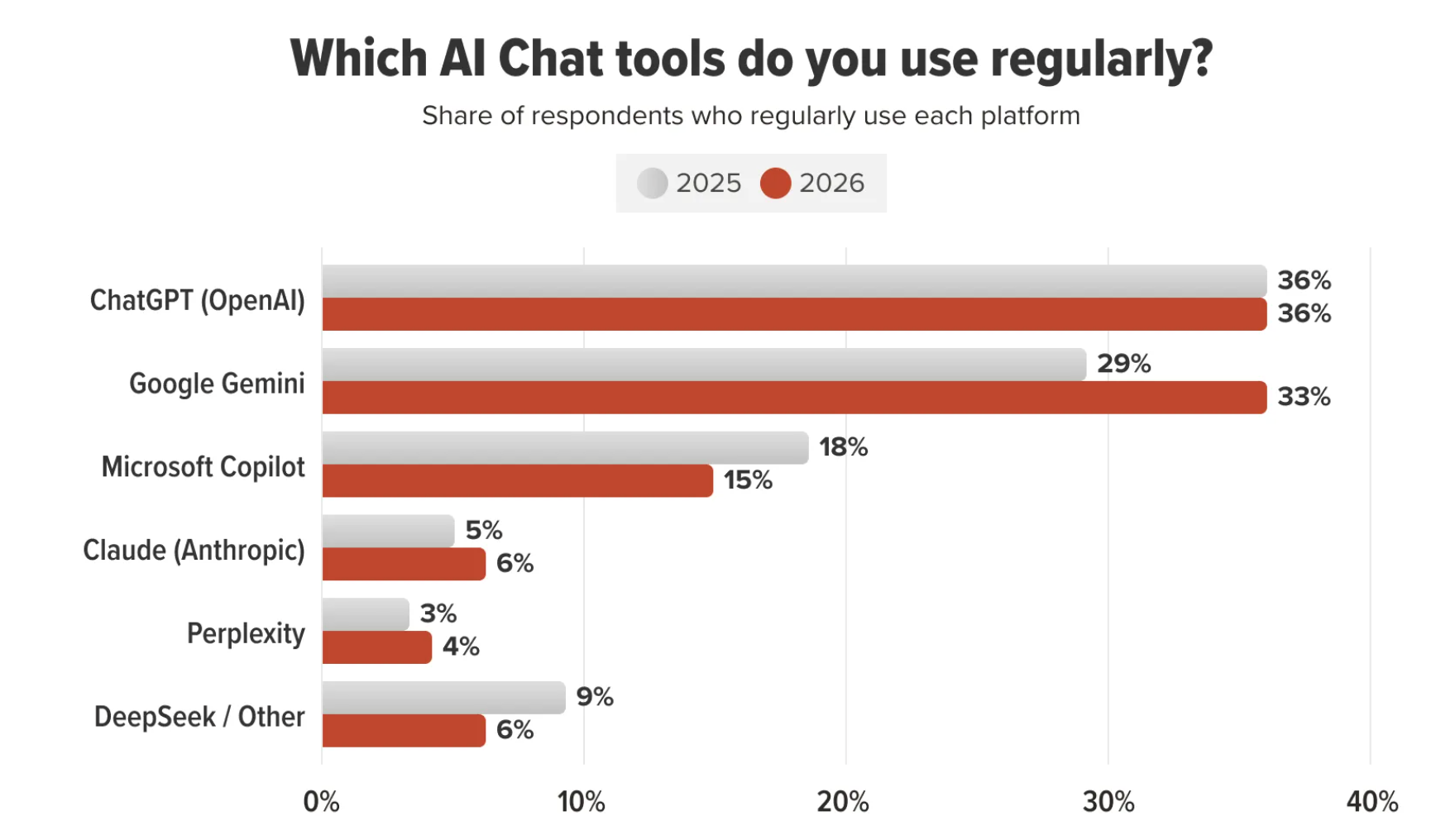
We've been doing consumer surveys on AI adoption for almost three years. It's interesting to compare our findings with others'. Most recently Andy Crestodina at Orbit Media fielded a survey about AI and search usage (n=1,110 US adults). Directionally it's consistent with what we're seeing: complex, evolving behavior and complementary AI-search usage patterns. Here are some of the survey's main findings:
- 55% of respondents "usually" or "almost always" use AI. ChatGPT is the most widely used AI. And usage frequency is up YoY.
- Google Gemini has grown significantly; Microsoft Copilot has declined YoY.
- AI is preferred for research-intensive tasks, e.g., "step-by-step" instructions, medical information, vacation planning and product recommendations.
- 41% are paying for AI, with Gemini showing strong growth. ChatGPT is flat.
- Traditional search (“usually use Search”) also showed meaningful growth YoY (7 points), perhaps reflecting some AI disenchantment.
- 70% of people are reading or engaging with Google AIOs in some form.
- 46% think AI will replace search, but this number is slightly down YoY.
- Google's biggest advantage is in local search: only 24% prefer AI.
Our data show people are making thoughtful decisions about when to use AI and when to use Google search. And trust is a complex question. They often do informational or background research with AI and then go to Google for brand, navigational or "last mile" queries. As the survey points out, local is an area of specific Google strength, though many people conduct local searches with AI. However, the distinction between AI and traditional search is breaking down as Google evolves the UI/UX (e.g., Ask Maps). Regardless of who eventually wins, AI is fundamentally changing user expectations and behavior (e.g., longer, more specific queries). Finally, the idea that AI is all hype because traffic referrals are <1% is entirely false and superficial.
AI Laggard May Yet Win
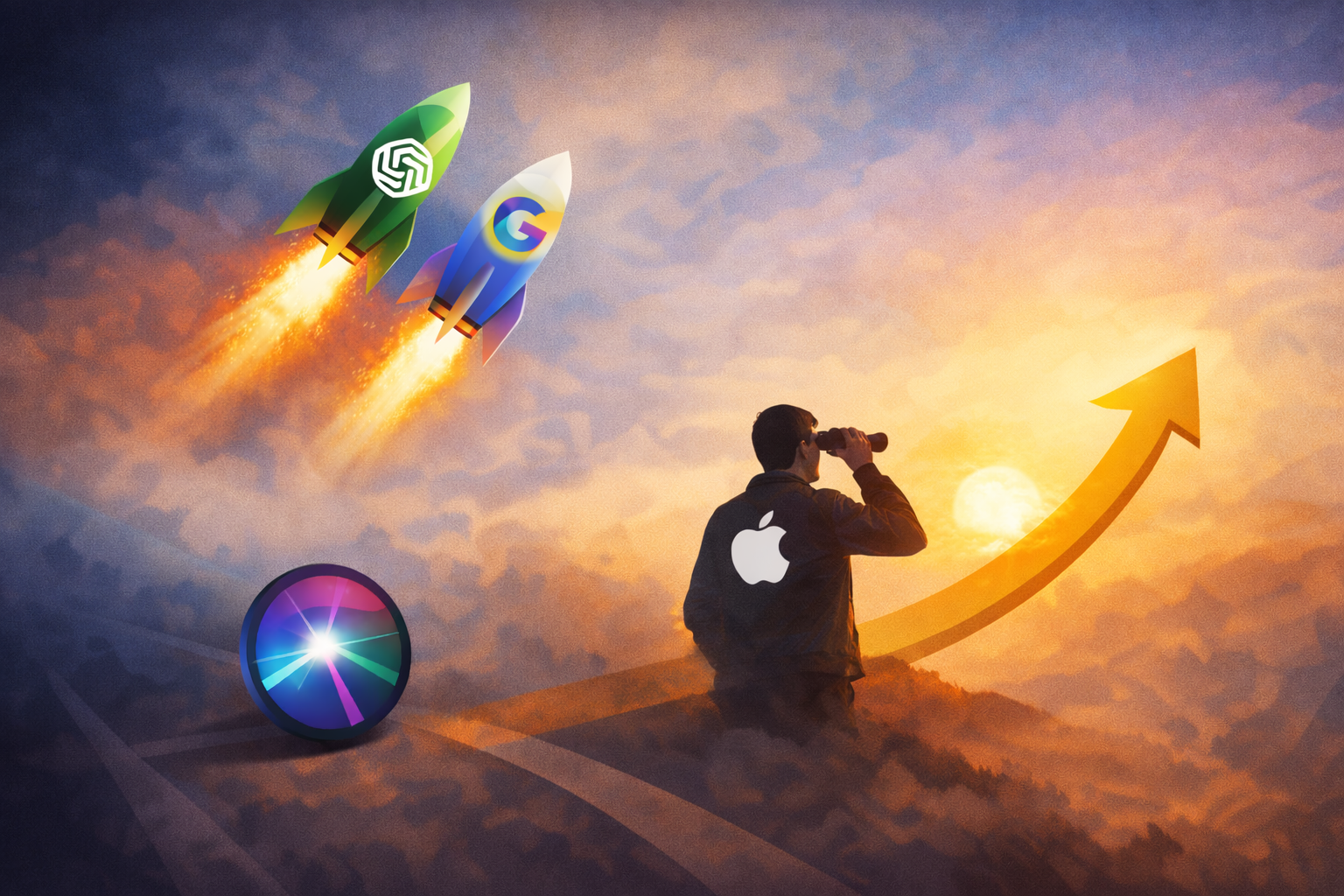
Apple has repeatedly and crudely stumbled in AI. Siri badly lags Google and ChatGPT in terms of what it can deliver. But for all its AI missteps Apple may still come out on top or at least be one of the winners. That's because, like Google, it has massive distribution. Apple has been collecting what amounts to tolls from AI developers through its App Store, to the tune of almost $900 million in fees in 2025 and will surpass $1 billion this year, according to WSJ reporting. Apparently about 75% of that comes from ChatGPT. Now, new details of Apple's relationship with Google Gemini as well as its longer-term AI strategy have also emerged. Apple will have "complete access" to Gemini and will be able to produce derivative or "distilled" smaller models that it can host, control and deploy for narrow purposes and which can run on Apple devices directly. Bloomberg has also reported that iOS 27 will allow multiple third party AI models to plug into Siri, enabling users to choose. This is consistent with what Apple originally sketched out with Apple Intelligence. What remains an open question, however, is whether this will all work given Apple's poor execution of the Siri-ChatGPT "integration." We'll learn more at Apple's developer conference in June.
Slippery Slope: AI-Enabled Journalism
Whether we like it or not, AI will be an integral, even central part of journalism going forward. The only question is how much transparency will surround its use. Two contrasting examples illustrate where things stand. The Wall Street Journal ran a story about Nick Lichtenberg, a writer at Fortune, who generates 2x the output of his colleagues and uses AI aggressively: "when news breaks Lichtenberg often uploads press releases or analyst notes into AI tools and prompts them to spit out articles he can edit and publish quickly." He's pumping out content, as many as seven stories a day, and being celebrated by Fortune's leadership as they struggle for relevance. If that model represents the unapologetic embrace of AI, the NY Times and others are coy about its use. Kate Gilgan, who recently wrote a "modern love" column for the Times was called out by several experts and observers on social media for allegedly undisclosed use of AI in that column. After a minor online uproar, Gilgan admitted to The Atlantic that she "did utilize AI as a tool [for] inspiration and guidance and correction ... as a collaborative editor and not as a content generator." This may be a distinction without a difference. What she conveys in her quotes is fairly heavy reliance on AI; however, she didn't disclose it. The Atlantic article also suggests that AI use in prestige publications (e.g., WSJ, NYT) may be more widespread than people know. One can understand the desire to take shortcuts with AI but it's a very slippery slope.
Lightning Round:
- ChatGPT formally closes mind-boggling $122 billion funding round.
- Despite criticism, ChatGPT ads reached $100M ARR in 2 months.
- AI content has now crossed the threshold of "good enough."
- OpenAI wants to be on the search engine "choice screen" in EU.
- Major study: 9.3M jobs at risk in next 2-5 years.
- AI sycophancy is purposeful with negative downstream outcomes.
- Better KPIs to capture the real impact of AI search.
- Google testing "guided search," which seeks to own the funnel.
- Challenged in enterprise and consumer markets, Meta goes after SMBs.
- OpenAI CFO Sarah Friar touts ChatGPT loyalty metrics.